


Waterfront Permits in BC: 4 Common Reasons Projects Get Delayed
Planning a waterfront project in BC? Learn the 4 common reasons dock and waterfront permits are delayed and how proper planning can keep your project moving.
One of the very first steps you need to take before building the residential dock of your dreams is securing the proper permits. Through our commitment to customer service excellence, we’ll make sure the proper permits are in place as quickly as possible. We want you to enjoy every aspect of the construction process, so we’ll work with you to ensure every detail is looked after, right down to applying for a permit.
At Shoreline Pile Driving, we understand the importance of your lakefront investment and are committed to environmental responsibility. That’s why we’ve partnered with Registered Professional Biologists (RPBios) to ensure that the highest environmental standards are upheld throughout the design and construction phases. By prioritizing sustainability and environmental stewardship, we not only enhance your property but also help protect the natural beauty of Okanagan Lake for generations to come. Let us guide you through the permitting process, ensuring compliance with all provincial and municipal regulations while making your waterfront vision a reality.
A successful waterfront project starts with strategic planning and expert guidance. At Shoreline Pile Driving, we handle the entire permitting process, ensuring a smooth and stress-free experience for our clients. Below is a step-by-step guide outlining the permits and approvals required for dock construction, repairs, and maintenance in British Columbia, with a focus on Okanagan Lake.
For more information on permit applications and their requirements, see the details below.
Water Sustainability Act (WSA s.39) – Any work conducted in or around water requires an application under the Water Sustainability Act. This application, referred to as a “notice of an authorized change,” is submitted through FrontCounter BC. Once the notice is received by a habitat officer, you may proceed with the proposed activity 45 days later, provided all terms and conditions , as well as any specific directives from a habitat officer or WSA engineer, are met.
An Approved Change (WSA s.11) is required for projects with greater environmental impact or significant water flow alterations, such as commercial developments, boat launches, or groyne removals. These projects cannot begin until formal approval is granted. Once approved, activities may proceed in compliance with the terms and conditions specified in the legal instrument.
Explore more by visiting the User’s Guide for Changes In and About a Stream in British Columbia.
A Crown Land Tenure Application is necessary if:
Waterfront property owners in British Columbia can build private residential docks on Crown land without a formal application if they follow General Permission guidelines. These regulations are designed to minimize environmental impact and preserve public access along the foreshore.
Please note, a variance application may be required for projects located within the District of Peachland or the District of Lake Country. Both municipalities have their own dock bylaws in place with design requirements.
Useful Resources for Private Moorage on Okanagan Lake:
Please note: An Environmental impact assessment (EIA), or a Qualified Environmental Professional checklist (QEP) may be required depending on property location, water depths, structure size, and color-zone. An Environmental Consultant (RPBio) of your choice can obtain these reports.
Minor Work – No formal approval is needed if the dock meets the following criteria:
For docks outside the scope of Minor Work, an “Notice of Works‘ application must be submitted to the Navigation Protection Program (NPP) for review and approval.
The Ministry of Environment introduced the Okanagan Region Large Lakes Foreshore Protocol in 2009, complete with foreshore sensitivity maps, risk ratings for specific development activities, and preferred procedures and practices. The combined use of this information will help to maintain important foreshore habitats.
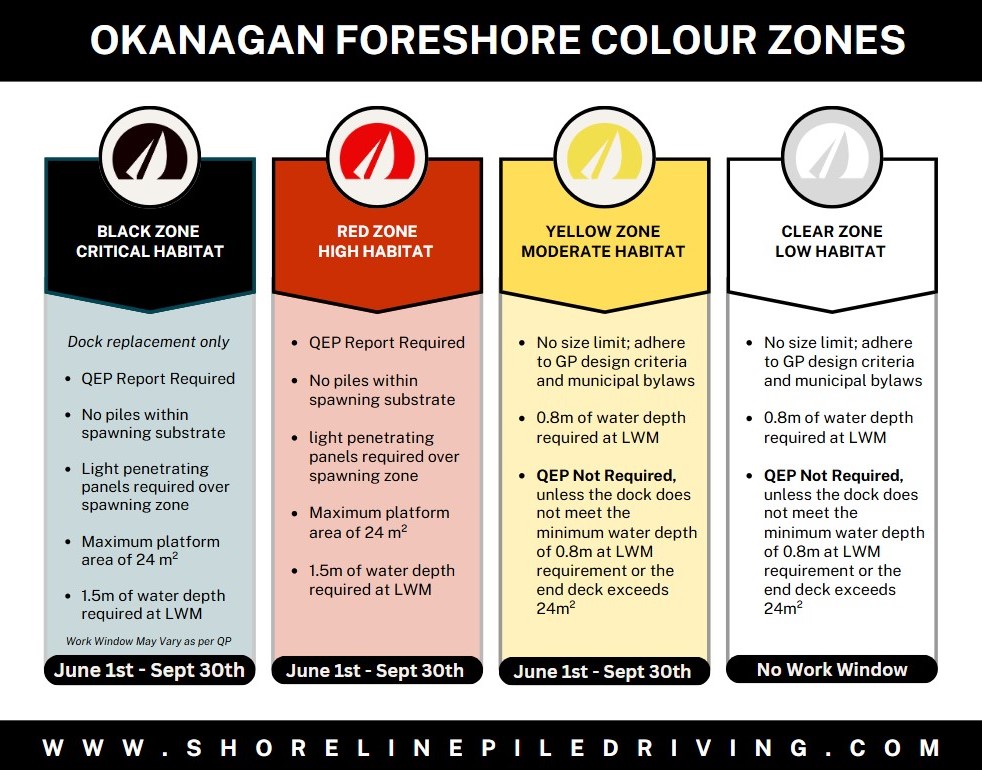
Exception: Decking or re-decking is permitted in any zone (January 15 to September 30) if accessed from shore and without causing significant vibrations.
Each color zone has a least risk timing window, and must be adhered to during the construction process.
Front Counter BC Kamloops for dock permit guidelines:
441 Columbia St, Kamloops, BC V2C 2T3
ph: 250-828-4131
em: FrontCounterBC.Kamloops@gov.bc.ca,
www.frontcounterbc.gov.bc.ca
If you’re ready to apply for the necessary commercial and residential dock permits, reach out. We’d love to help! Contact us online or call us at (250) 769-7694.
© 2026 Shoreline Pile Driving. All Rights Reserved. Privacy & Terms. Website by Catalyst Marketing Cooperative


